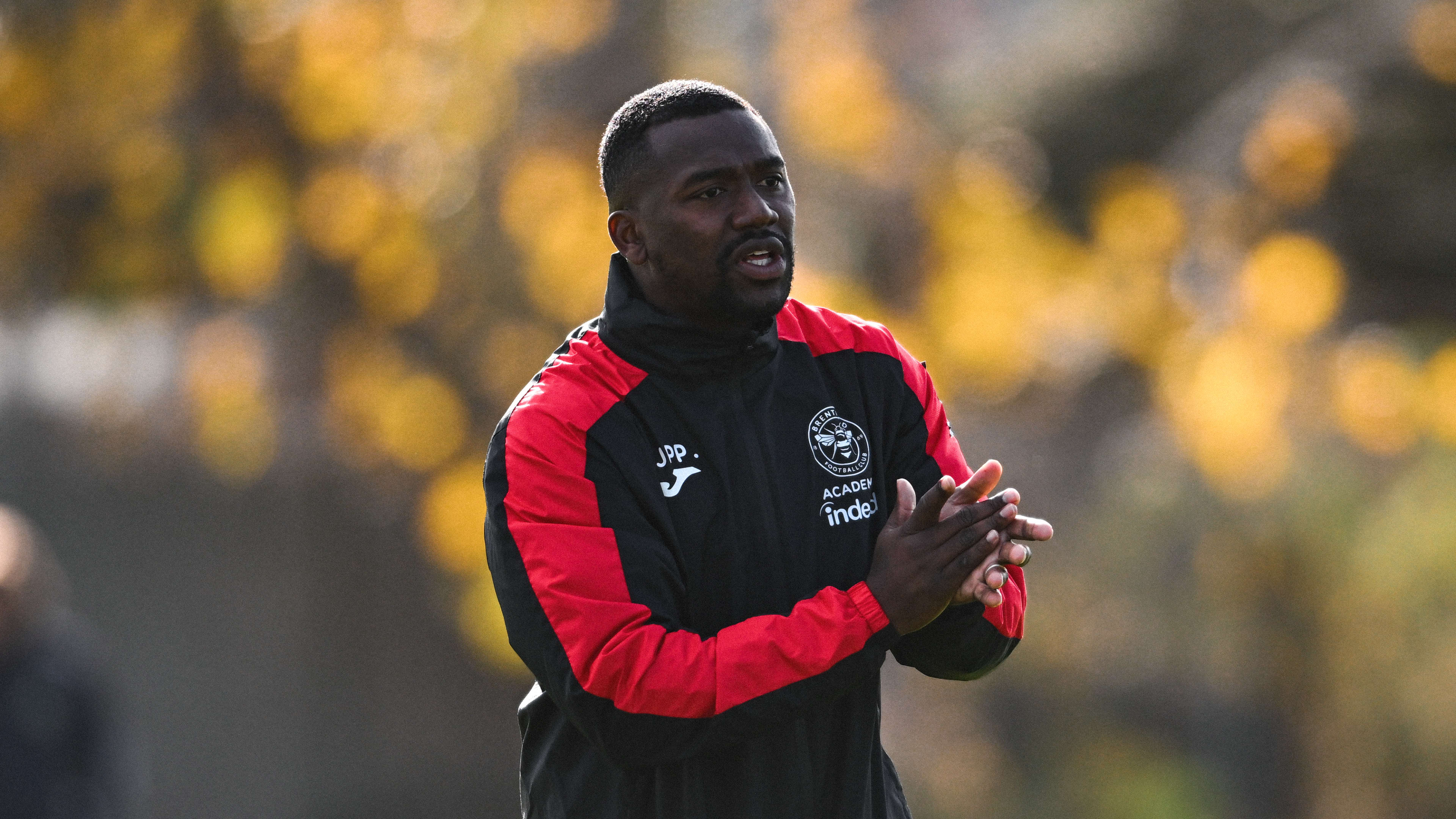
Jon-Paul Pittman’s story begins in Oklahoma, USA.
“I've got an American passport," he revealed. "My dad was in the American Air Force and was stationed over there when I was born.
“Very quickly after, he got stationed in Europe, so we moved over here.
“I played lots of different sports, which helped me later in life. I tried basketball but was way too short for that! And a bit of American football when we could get enough players."
Despite being introduced to a myriad of sporting opportunities, as soon as football came along, there was only one route for Pittman.
He remembered: “My mate knocked for me one day and said, 'Do you want to come to football training?’
“In my double denim, I went and joined in. I think I had Chelsea boots on as well!
“I got home and my mum wasn't happy with me covered in mud, but I knew this was the game for me.
"You get to kick the ball and, sometimes, you get to kick people as well!”
"In my double denim and Chelsea boots, I joined in! My mum wasn't happy with me covered in mud, but I knew this was the game for me"
The former Forest, Wycombe and Grimsby winger reflected on his academy days in Nottingham.
“I spent eight years in Forest’s set-up. They did some wonderful things at that time, winning the FA Youth Cup with Jermaine Jenas, Michael Dawson, Marlon Harewood," he reminisced.
“Wes Morgan was hugely influential on us as scholars. He had a slightly different journey, coming into the programme. I still speak to him today.
“Eventually, making my debut at Forest was special, because lots of the people I started with at 12 years old weren’t in the game anymore. I had pushed myself and earned my place.”
Pittman described how academy football has changed and the lessons he takes from his career to teach the next generation.
“I look back with fond memories,” he explained. “It was tough and I appreciate what the guys go through that I'm coaching here. You sacrifice a lot and you're not sure what's going to come out at the end of it.
“Doing the basics well can't be overlooked. With the support the lads get here, they're in an unbelievable position to go and have fantastic careers, not just in football, but in any part of life.”
Before assuming his current role as individual development plan coach, Pittman took over as interim head coach of the Under-18s after Lydia Bedford’s departure midway through the 2024/25 season.
“I'm enjoying the new role. I’ve been able to apply the things I've worked on during my A license, my cognitive therapy diploma, and at university.
“I recently graduated from Leeds Beckett with a Master's degree in sports coaching. A lot of it centred on skill development and understanding the person behind the performer.
“When you're the IDP coach, you sit alongside with a slightly different lens, looking at how the individuals come together.”
"I recently graduated from Leeds Beckett University with a Master's degree in sports coaching. A lot of it centred on skill development and understanding the person behind the performer"
Pittman explained how he leads on building player-specific individual development plans for Gary McDermott's Under-18s side, and the teamwork and detail that goes into the tailor-made programmes.
“We look at the individual’s qualities and why we brought them to the club in the first place,” he said.
“Then we plan how we can enhance things they're good at and bring the things that they're not so good at to a level where it doesn't become a barrier.
“After we've established that, we co-create with the players; it's not just us telling them what they need. The player has a say because it's their development, and we always want them to have agency and autonomy.
“I've been head coach, assistant coach, and now I’m an individual coach. I've got a real breadth of knowledge for this age group, and I see how it transpires into professionals."
Reflecting on his various roles at Brentford's academy, Pittman used the analogy of filling a jar with rocks to explain his diversity of experiences.
“Being the head coach last season was different," he began. "You're making sure that everything's running smoothly, managing minutes and the playing style. You're the rocks.
“When you're assisting, you're putting pebbles in, little bits of detail to help build a player's skillset.
"Then the individual development is like the sand that fills those gaps in between. We're building a solid foundation, working on areas that the player may be missing.
“Gary, Kieran [Driscoll] and Daniel [Hill] have been great to work with because they understand my role and how it sits within the interdisciplinary team.”
During his career, Pittman had the unique experience of playing three finals at Wembley in the space of 12 months, all with Grimsby Town.
Although it was a rollercoaster of highs and lows, Pittman has vivid and varying memories of every chance he got to play on the hallowed turf.
He joked: “By the third time we got there, we were like, ‘Oh, this again?!'
“I missed a penalty in the play-off final against Bristol Rovers in front of 50,000 people. I bumped into some fans at Gordano services a couple of years afterwards and they were still singing songs and bantering me.
“We then got promoted against Forest Green Rovers, which was a magical moment. It means a lot when a small fishing town like Grimsby gets to Wembley.
“Pretty much the whole population was there. They’d been non-league for so long, so celebrating with the fans was amazing.
“We lost to Halifax in the FA Trophy a week later. The gaffer gave us a little bit more time off, which I think some of the lads enjoyed a bit too much!”
At another point in his journey, Pittman had a crossroads moment that could have seen him move back across the pond.
“There were times when Major League Soccer was calling. I was due to go and sign for Orlando City, they were a new franchise and it was all looking likely,” he recalled.
“Then suddenly the deal was off. I was a bit dejected, then a couple of weeks later, they announced that they'd signed Kaká. I was like, ‘Okay, fair enough!'
“I'm glad it worked out that way because I wouldn't be here at Brentford now and part of the wonderful things that we're doing. Our vision is clear and everyone pulls in the same direction.
“It's no surprise that everybody I speak to or any article you read is positive about Brentford because it's full of great people.”